
Presented by Dr. JASON
The journey from a scientific discovery to an approved medicine is one of the most complex and highly regulated processes in healthcare. Every successful medicine represents years of research, collaboration, laboratory testing, and clinical evaluation. At the center of this process are pharmaceutical professionals—scientists, pharmacists, chemists, clinicians, engineers, regulatory specialists, and quality experts—who work together to develop safe, effective, and high-quality medicines.
This article explores the critical role pharmaceutical professionals play throughout the drug development lifecycle and highlights how their expertise continues to shape the future of modern medicine.
Understanding Drug Development
Drug development is a multidisciplinary scientific process that transforms promising laboratory discoveries into medicines that may eventually become available for clinical use after extensive testing and regulatory review. It requires collaboration across numerous scientific disciplines while maintaining rigorous ethical and quality standards.
The major stages include:
- Drug discovery
- Laboratory and preclinical research
- Pharmaceutical formulation
- Clinical research
- Regulatory review
- Manufacturing
- Quality assurance
- Post-market safety monitoring
Each stage depends on highly trained professionals with specialized expertise.
Pharmaceutical Scientists
Pharmaceutical scientists investigate the chemical and biological properties of compounds that may have therapeutic potential. Their responsibilities include:
- Identifying promising drug candidates
- Designing laboratory experiments
- Studying molecular interactions
- Developing new formulations
- Evaluating stability and compatibility
- Supporting innovation in pharmaceutical technology
Their work forms the scientific foundation for future medicines.
Medicinal Chemists
Medicinal chemists design and optimize molecules to improve their biological activity while reducing unwanted effects.
Their work includes:
- Molecular design
- Chemical synthesis
- Structure-activity relationship (SAR) studies
- Optimization of lead compounds
- Chemical characterization
- Collaboration with pharmacologists and biologists
Medicinal chemistry bridges organic chemistry with pharmacology to support drug discovery.
Clinical Pharmacologists
Clinical pharmacologists study how medicines interact with the human body by examining:
- Drug absorption
- Distribution
- Metabolism
- Elimination
- Dose optimization
- Drug interactions
- Pharmacokinetics
- Pharmacodynamics
Their research helps improve the understanding of medicine safety and effectiveness.
Analytical Chemists
Analytical chemists ensure pharmaceutical quality through laboratory testing and method development.
Common analytical techniques include:
- High-Performance Liquid Chromatography (HPLC)
- Gas Chromatography (GC)
- Mass Spectrometry (MS)
- UV-Visible Spectroscopy
- Infrared Spectroscopy
- Dissolution testing
- Stability testing
These methods help verify identity, purity, potency, and consistency throughout product development.
Pharmaceutical Engineers
Engineers translate laboratory discoveries into scalable manufacturing processes by developing:
- Manufacturing systems
- Process optimization
- Equipment validation
- Production efficiency
- Quality control systems
- Automation technologies
Engineering expertise helps maintain consistent product quality during manufacturing.
Regulatory Affairs Specialists
Regulatory professionals work closely with national and international health authorities to ensure that pharmaceutical development complies with applicable regulations.
Their responsibilities include:
- Preparing regulatory submissions
- Coordinating scientific documentation
- Managing compliance activities
- Monitoring changing regulations
- Supporting product lifecycle management
They help ensure scientific data is presented accurately and transparently.
Quality Assurance and Quality Control
Quality professionals help maintain high standards throughout pharmaceutical development.
Their responsibilities include:
- Good Manufacturing Practice (GMP)
- Good Laboratory Practice (GLP)
- Documentation management
- Process validation
- Risk assessment
- Internal audits
- Corrective and preventive actions (CAPA)
Robust quality systems contribute to reliable and reproducible manufacturing processes.
The Importance of Team Collaboration
Drug development requires collaboration among professionals from many disciplines, including:
- Pharmacists
- Physicians
- Biologists
- Toxicologists
- Biostatisticians
- Clinical research associates
- Biomedical scientists
- Manufacturing specialists
- Data scientists
- Regulatory experts
This multidisciplinary approach supports innovation while helping maintain scientific rigor.
Emerging Technologies
Modern pharmaceutical professionals increasingly use advanced technologies such as:
- Artificial Intelligence (AI)
- Machine Learning
- Computational Drug Design
- Genomics
- Precision Medicine
- Biotechnology
- Digital Health
- Laboratory Automation
- Advanced Data Analytics
These technologies are accelerating scientific discovery and improving research efficiency.
Career Opportunities
Pharmaceutical science offers rewarding careers across healthcare and research, including:
- Pharmaceutical Scientist
- Clinical Pharmacologist
- Medicinal Chemist
- Analytical Chemist
- Biomedical Scientist
- Regulatory Affairs Specialist
- Quality Assurance Manager
- Manufacturing Scientist
- Biotechnology Researcher
- Clinical Research Professional
These careers contribute to improving healthcare through scientific research and innovation.
Conclusion
Pharmaceutical professionals are essential to every stage of drug development, from early scientific discovery to quality assurance and post-market monitoring. Their combined expertise in chemistry, biology, engineering, pharmacology, clinical research, and regulatory science helps advance medical knowledge and supports the development of safe, effective, and high-quality medicines.
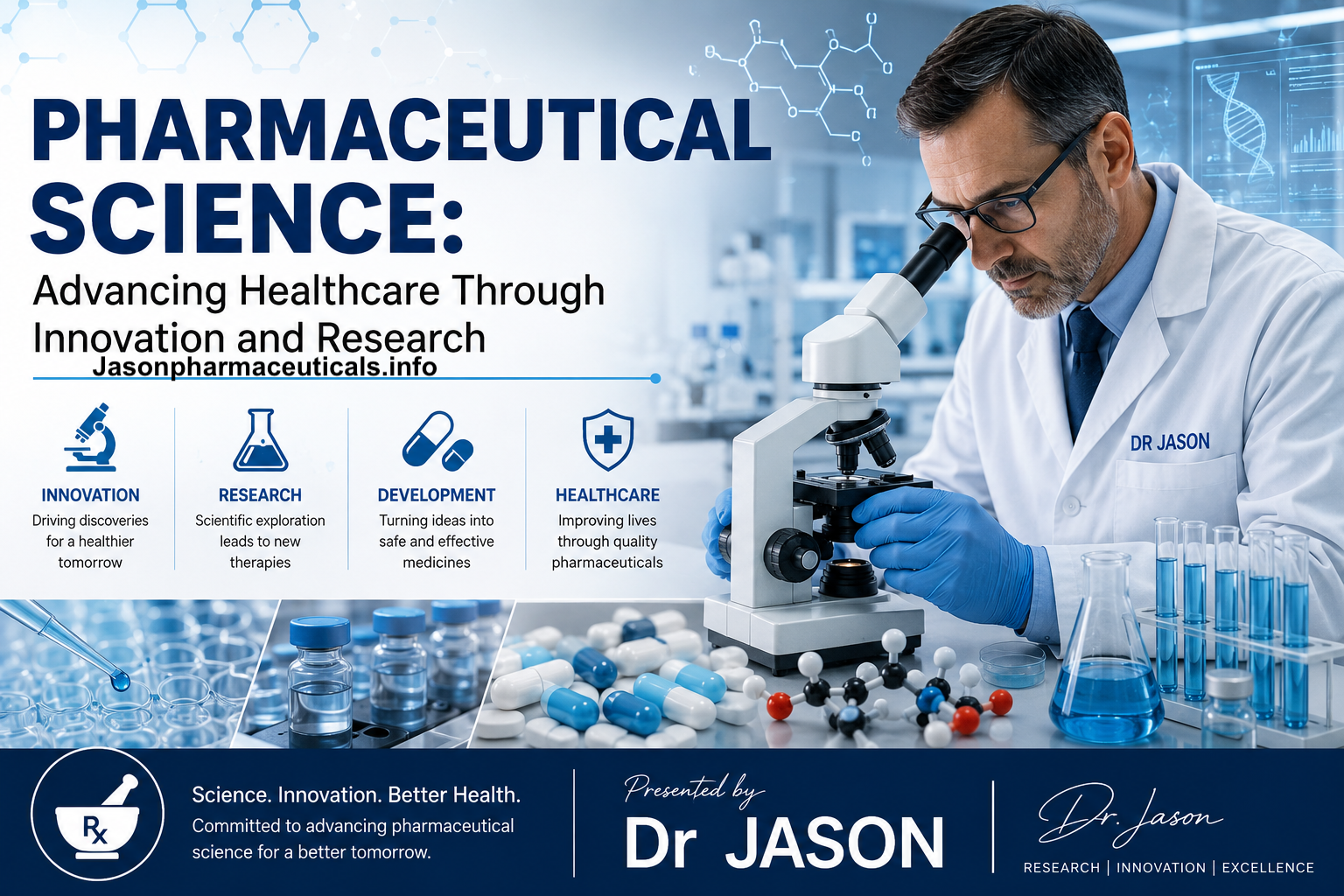
Presented by Dr. JASON, this educational article highlights the collaborative nature of pharmaceutical science and emphasizes the importance of evidence-based research, ethical practices, and continuous innovation in advancing modern healthcare.
The Role of Pharmaceutical Professionals in Drug Development, Pharmaceutical Science, Drug Discovery, Clinical Pharmacology, Medicinal Chemistry, Pharmaceutical Analysis, Biomedical Science, Laboratory Research, Drug Development Process, Pharmaceutical Technology, Clinical Research, Biotechnology, Quality Assurance, Quality Control, Regulatory Affairs, Good Manufacturing Practice, Analytical Chemistry, Pharmaceutical Innovation, Healthcare Research, Dr. JASON.
Leave a Reply