

Presented by Dr. JASON
Laboratory research is the foundation of scientific discovery, providing the knowledge and evidence that drive advances in medicine, biotechnology, pharmaceutical science, and public health. Through carefully designed experiments, rigorous analytical methods, and evidence-based investigation, laboratory researchers contribute to a deeper understanding of biology, chemistry, disease mechanisms, and the development of new technologies that improve lives around the world.
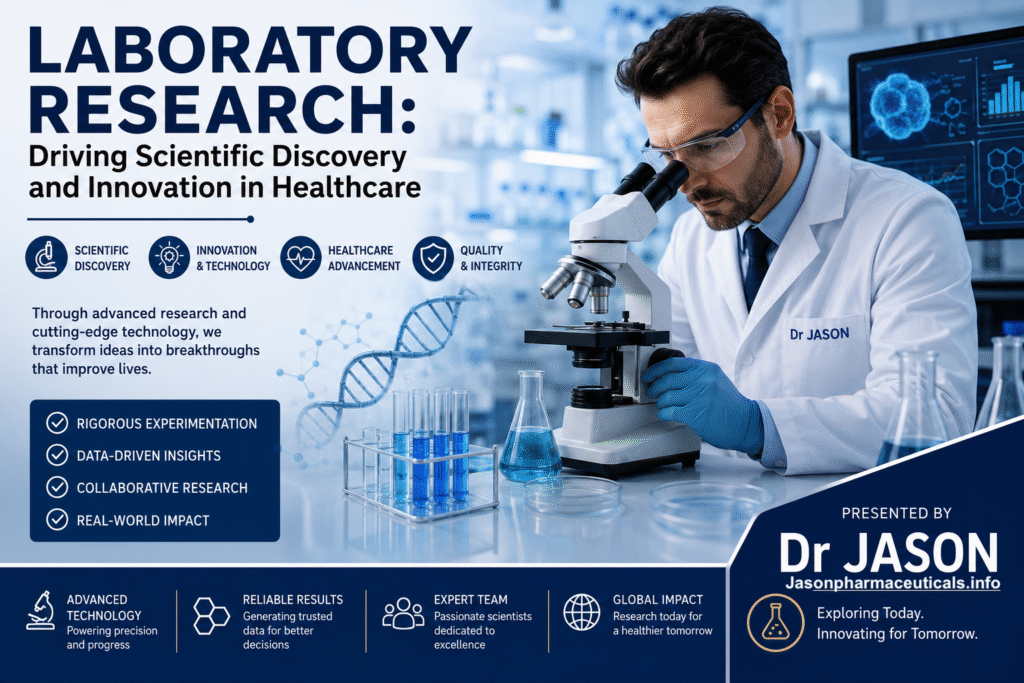
At Jason Research Chemicals, Dr. JASON is committed to promoting scientific education by providing informative resources on laboratory research, analytical chemistry, pharmaceutical science, medicinal chemistry, and modern research methodologies. Our educational content is designed to support students, educators, researchers, and laboratory professionals seeking accurate and up-to-date scientific information.
What Is Laboratory Research?
Laboratory research is the systematic investigation of scientific questions in controlled environments using standardized techniques, specialized instruments, and validated experimental methods. Researchers collect, analyze, and interpret data to expand scientific knowledge, evaluate hypotheses, and support innovation across numerous disciplines.
Laboratory research plays an essential role in:
- Pharmaceutical science
- Medicinal chemistry
- Biotechnology
- Molecular biology
- Clinical research
- Toxicology
- Microbiology
- Analytical chemistry
- Environmental science
- Biomedical research
Each of these fields depends on high-quality laboratory practices to generate reliable and reproducible scientific data.
The Importance of Laboratory Research
Many of today’s medical treatments, diagnostic tools, and healthcare technologies began as laboratory investigations. Laboratory research contributes to:
Drug Discovery
Researchers identify and evaluate molecules that may have therapeutic potential, helping scientists better understand disease mechanisms and biological targets.
Disease Research
Laboratory studies improve our understanding of infectious diseases, cancer, neurological disorders, cardiovascular conditions, metabolic diseases, and rare genetic disorders.
Diagnostic Innovation
Scientists develop and refine laboratory techniques that support earlier, more accurate disease detection and monitoring.
Public Health
Laboratory research informs public health initiatives by improving disease surveillance, advancing vaccine research, and supporting evidence-based healthcare practices.
Major Areas of Laboratory Research
Pharmaceutical Research
Scientists investigate the chemical, physical, and biological properties of compounds to support drug discovery and pharmaceutical development.
Molecular Biology
Researchers study DNA, RNA, proteins, and cellular processes to better understand genetics, disease mechanisms, and biological function.
Analytical Chemistry
Analytical laboratories use advanced instrumentation to identify, characterize, and quantify chemical substances with high precision and accuracy.
Microbiology
Microbiologists investigate microorganisms, including bacteria, fungi, viruses, and other microbes, to understand their role in health, disease, and the environment.
Biotechnology
Biotechnology research combines biology and technology to develop innovative solutions for medicine, agriculture, and industrial applications.
Essential Laboratory Techniques
Modern laboratories rely on a wide range of analytical and experimental methods, including:
- Chromatography
- Mass Spectrometry
- Nuclear Magnetic Resonance (NMR)
- Infrared (IR) Spectroscopy
- UV-Visible Spectroscopy
- Polymerase Chain Reaction (PCR)
- DNA Sequencing
- Cell Culture
- Microscopy
- Immunoassays
These techniques help researchers generate reliable scientific data and support reproducible results.
Laboratory Quality and Scientific Integrity
High-quality laboratory research depends on rigorous standards and ethical practices. Key principles include:
- Accurate documentation
- Method validation
- Equipment calibration
- Quality assurance
- Quality control
- Data integrity
- Reproducibility
- Ethical research practices
Many laboratories also operate under internationally recognized quality systems such as Good Laboratory Practice (GLP) and other applicable standards.
Emerging Technologies in Laboratory Research
Scientific laboratories continue to evolve with new technologies, including:
- Artificial intelligence for data analysis
- Machine learning applications
- Laboratory automation
- Robotics
- High-throughput screening
- Genomics
- Proteomics
- Bioinformatics
- Nanotechnology
- Digital laboratory information systems
These innovations improve efficiency, enhance data quality, and accelerate scientific discovery.
Careers in Laboratory Research
Laboratory research offers diverse career opportunities across academia, healthcare, government, and industry, including:
- Research Scientist
- Analytical Chemist
- Pharmaceutical Scientist
- Biomedical Researcher
- Molecular Biologist
- Microbiologist
- Toxicologist
- Laboratory Technologist
- Biotechnology Scientist
- Quality Assurance Specialist
These professionals work collaboratively to advance scientific knowledge and improve human health.
The Future of Laboratory Research
As science continues to advance, laboratory research will remain central to innovation in medicine, biotechnology, environmental science, and public health. Developments in artificial intelligence, precision medicine, advanced analytical instrumentation, and computational biology are transforming the way research is conducted and enabling scientists to answer increasingly complex questions.
Collaboration among researchers, healthcare professionals, educators, and industry experts will continue to drive discoveries that benefit society and improve healthcare worldwide.
Conclusion
Laboratory research is a cornerstone of scientific progress. Through careful experimentation, advanced analytical techniques, and evidence-based investigation, researchers generate the knowledge that supports innovation across pharmaceutical science, biotechnology, and medicine.
Presented by Dr. JASON, Jason Research Chemicals is dedicated to providing educational resources on laboratory research, pharmaceutical chemistry, medicinal chemistry, analytical science, and biomedical innovation. Our mission is to promote scientific literacy, encourage evidence-based learning, and support the next generation of researchers and healthcare professionals through accurate, high-quality educational content.
Laboratory Research, Scientific Research, Pharmaceutical Science, Pharmaceutical Chemistry, Analytical Chemistry, Medicinal Chemistry, Biotechnology, Biomedical Science, Molecular Biology, Drug Discovery, Laboratory Techniques, Chromatography, Mass Spectrometry, Quality Assurance, Good Laboratory Practice, Scientific Education, Jason Research Chemicals, Dr. JASON
Leave a Reply